What are 'Storynotes'?
- Philosophy
- December 19, 2025
Back in the lockdown days, which came in just after I’d told my first tale or two at the Island Storytellers, and my first folk night tale at the Porter Club in Lake, I started cobbling together some research notes on “the sin eater”, a legendary, or perhaps mythical, figure from Welsh folklore that I’d learned of from a tale told by Ceri Phillips.
The hunt for evidence relating to the existence, or otherwise, of this character, took me on a journey through 19th century newspapers and periodicals, and will, I hope, form the basis of a “proper” book at some point. But it also started me down the path of creating my own story research notes, or storynotes, in general.
These research notes take two main forms, depending on the subject matter:
- notes relating to traditional stories;
- notes relating to historical tales.
In each case, the motivation is to provide a solid traditional or historical basis ["historical" in the sense of old, or "as was believed at the time"; I will return to his in a later post...] for a tale to be told. For traditional tales, this typically takes the form of finding multiple variants of a particular tale, ideally collected from an oral source, and published at least a hundred years ago. For historical tales, the source material primarily comes in the form of news reports contemporary to the historical event I am interested in, or “old days remembered” columns from newspapers in the decades after the event, although still at least a hundred years old.
Over the last few years, I have started numerous storynotes collections, including “general” folk tales, Island tales (which is to say, stories relating to the Isle of Wight, and which may either be legends or historical tales), protest tales, winter tales, Irish tales, mediaeval tales and specific event related tales.
All my storynotes are posted in public online repositories, which include notes in vatious states of disrepair. When a storynote is in a “readable” condition (and in some cases, even when it isn’t), I “publish” it via a simple website. For example, Island storynotes or Winter Tales. You can probably find many of the other collections, of both the “published” notes and the raw notes, without too much difficulty…
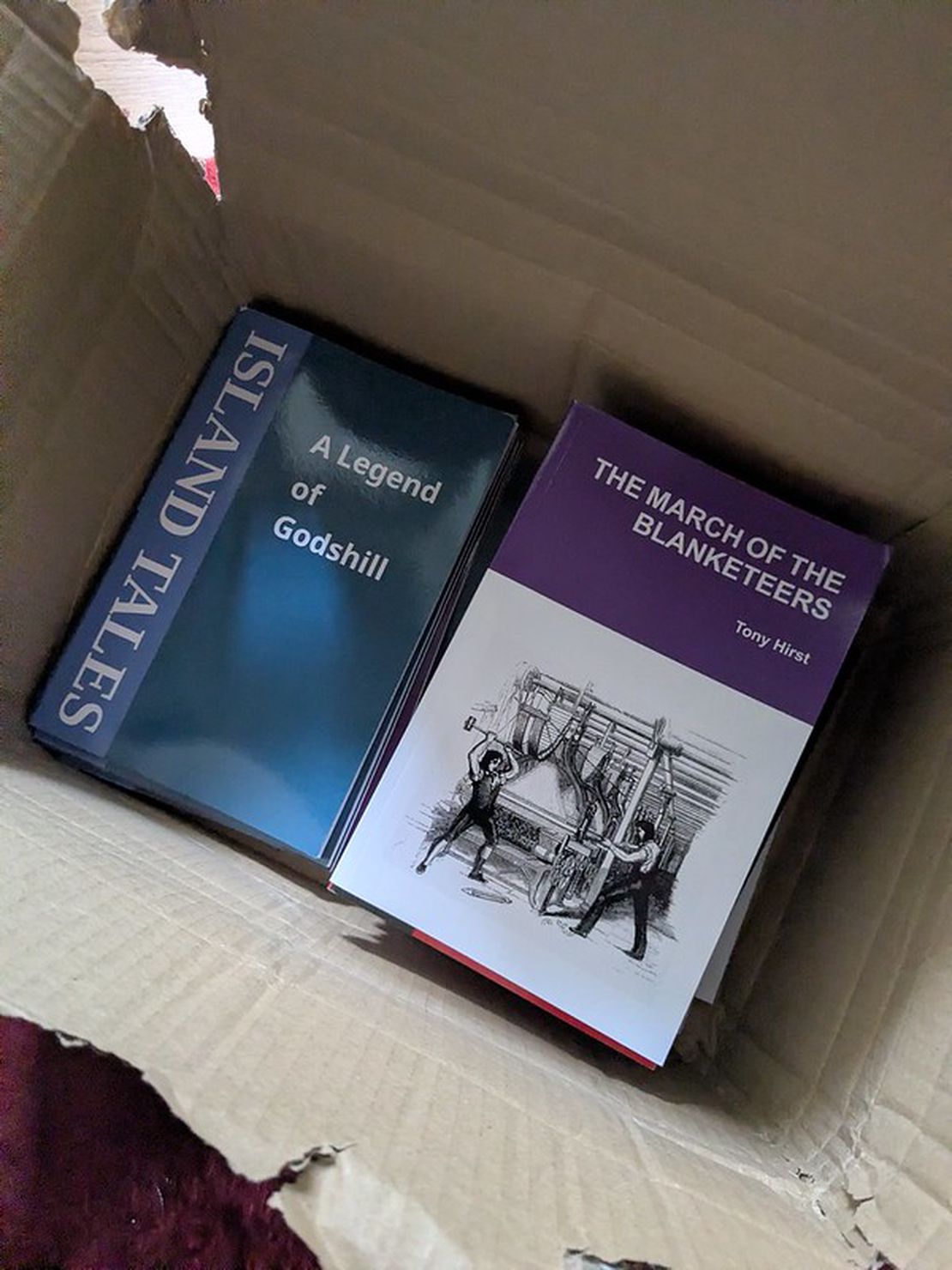
More recently, I’ve also started publishing some storynotes as A5 print booklets. The first run is typically one or two copies via the Lulu print-on-demand service. This gives me a hard copy (and at a cheaper price and more conveniently than printing it myself) that I can use to proof read, edit and scrawl all over. When the text is reasonably stable, I then publish it via Amazon’s KDP service. This gives me access to cheaper printed copies than I can get from Lulu that I can use as promotional items, or sell as merch, in a stock controlled print-on-demand way. (It would be lovely to do proper print runs, but that means stumping up for at least 150-200 copies or more to make it available on a per unit basis, and also having to store the box or boxes the booklets are delivered in for the months and years it will take to actually get rid of them!)
I’ll have a bit more to say about the promotional and merch uses of the booklets in another post. And as to how I actually use the storynotes to help me come to a telling of a particular tale, I’ll also save that for another day.
So far, I have published storynotes into three separate series on Amazon: Island Tales, Protest Tales, and Dark Tales (more additions to each series, and several other new series, to come in 2026). The main reason for me using Amazon is so I can get affordable print-on-demand copies for promotional use, or to sell for about the price of a pint (a fiver); a consequence of using KDP is that the books are also available via Amazon, either as printed booklets (£6-8, depending on page count), or as e-books (£3.50). I’ll explain the pricing policy in a later post.